


For many years, the Bioceanic Route has been discussed with the same mix of enthusiasm and skepticism that typically accompanies South American integration projects. Many have been announced; few have materialized. This time, however, the picture appears to be different.
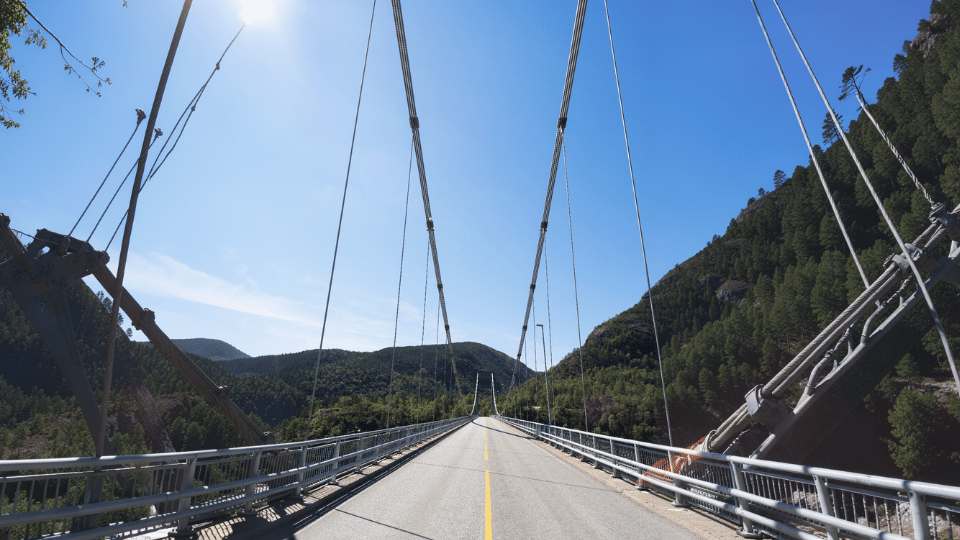
In July, the two ends of the international bridge over the Paraguay River were connected, physically linking Porto Murtinho, in the State of Mato Grosso do Sul, Brazil, to Carmelo Peralta, in Paraguay. There is nothing unprecedented about the construction of a border bridge; what makes this moment unique is what that connection represents: a road corridor of approximately 2,400 kilometers crossing Brazil, Paraguay, Argentina, and Chile, connecting Brazil—and more specifically the Brazilian Midwest—to Pacific ports.
The promise is to reduce cargo transit time between Mercosur and Asia by as much as two weeks, lowering freight costs for products arriving in Brazil and departing for Asian markets.
As usual, public debate tends to focus on concrete, asphalt, and the associated procurement contracts. Yet a logistics corridor is, above all, a legal construction. Customs procedures, contracts, taxation, insurance, and liability regimes constitute the invisible infrastructure without which the bridge remains little more than an engineering project.
From Infrastructure Project to Logistics Corridor
It is important to distinguish the bridge from the corridor.
While the bridge itself is virtually complete, there are still stretches of roadway in Brazil and Paraguay that remain to be paved. In Argentina, the route includes segments crossing elevations above four thousand meters, creating their own operational and climatic constraints.
In that sense, the international bridge represents only one element of a much more complex undertaking, with several important issues still unresolved.
The situation is no different from a legal perspective.
The inauguration and full operation of the Bioceanic Route also depend on the ability to implement customs, immigration, sanitary, and security controls, without which the anticipated opportunities will remain merely theoretical.
For businesses, this means that the next two to three years will be a period of transition and preparation, and contracts negotiated during this phase should be structured with that uncertainty in mind.
Neighbors First
Discussions about the Bioceanic Route often focus on Shanghai, Hong Kong, and other Asian economic hubs, while overlooking Asunción, Salta, and Antofagasta.
Although Asian imports are expected to benefit from the shorter Brazil-Asia connection, the most immediate—and likely the most enduring—opportunities lie with South America’s neighboring countries.
Paraguay is perhaps the most obvious example.
A landlocked country located in the heart of South America, with no direct access to the oceans and historically dependent upon foreign road and river networks to transport its production, now finds itself positioned along the principal route connecting two oceans.
The Paraguayan Chaco, previously isolated, gains paved access not to one but to two oceans.
For Brazilian investors, the Maquila Law (Law No. 1,064/97) and Paraguay’s reduced tax burden, combined with its proximity to Mato Grosso do Sul, make shared production arrangements in agribusiness, meat processing, agricultural inputs, logistics, and service exports increasingly feasible, all within the broader framework of Mercosur rules.
Argentina offers another important dimension.
The northwestern Argentine provinces crossed by the Bioceanic Route contain significant lithium reserves, commonly referred to as the Lithium Triangle. In addition, Argentina’s large-investment incentive regime, known as RIGI (Law No. 27,742 and related regulations), has attracted substantial capital flows to the region.
The corridor therefore creates opportunities, among many others, for Brazilian suppliers of equipment, engineering services, transportation solutions, and long-term supply contracts.
Chile, finally, functions not only as the exit point to the Pacific but also as a market in its own right.
With one of the world’s broadest networks of free trade agreements, Chile may also serve as a platform for logistics services, warehousing, and distribution, opening a new range of opportunities for Brazilian companies.
The Asian Window
With respect to Asia, the advantage relates to time and cost, not market access.
The difference lies in the competitiveness of perishable and higher-value-added products, such as meat, dairy products, pulp, and manufactured goods, for which fifteen fewer days in transit can make a significant difference.
On the import side, the route is expected to benefit Brazil’s Midwest region in the acquisition of fertilizers, machinery, and electronics.
Here, the legal challenge is primarily contractual and customs-related.
Transactions involving Asian counterparties and transportation across four jurisdictions require special attention to the allocation of risks between sellers (exporters) and buyers (importers), considering the various legal systems through which the goods will pass.
It is worth noting that Brazil, Argentina, Chile, and Paraguay are all signatories to the United Nations Convention on Contracts for the International Sale of Goods (CISG), which at least provides a common framework of substantive law, provided the parties do not opt out of its application inadvertently.
The Legal Challenges
The first challenge is customs-related.
The effectiveness of the route will depend on implementing integrated border controls, harmonized operating schedules and systems, and, ideally, a single customs transit regime extending from Porto Murtinho to Chilean ports.
Without such measures, time saved at sea may simply be lost at border crossings and customs facilities.
The second challenge concerns civil liability and insurance.
Cargo lost in Chile, Argentina, Paraguay, or Brazil may become subject to different carrier liability regimes, each with distinct indemnification limits and limitation periods.
Carrier liability insurance and cargo insurance must therefore provide effective coverage throughout the entire route, something that is not always guaranteed today.
The third challenge is tax and regulatory in nature.
In Brazil, the transit of goods through Mato Grosso do Sul revives discussions regarding ICMS, the applicability of import duties to Chilean or Argentine goods merely transiting through Brazilian territory, and state tax incentives designed to attract logistics centers—an issue made even more complex by the ongoing Tax Reform.
There is also competition among municipalities in Mato Grosso do Sul seeking to establish themselves as the principal “gateway” to the corridor, a dynamic likely to generate disputes involving incentives and public infrastructure investments.
The legal challenges are numerous.
But so are the opportunities.
Law as Infrastructure
The Bioceanic Route is, to a significant extent, a wager on the ability of four countries to harmonize rules that, historically, each preferred to keep to itself.
Building the bridge between Brazil and Paraguay was the easy part.
Completing it took four years.
Building the legal environment that makes it genuinely useful may take longer.
Yet it is precisely there that the future of the corridor will be decided—whether it becomes a shortcut to the Pacific or merely a well-built road across the Paraguayan Chaco.
For companies, the urgent priority is planning.
Those who move first—through properly structured contracts, adequate insurance coverage, robust tax planning, and effective environmental and social due diligence—will be the ones reaching the Pacific ahead of their competitors.
Available at: https://www.migalhas.com.br/amp/depeso/467470/o-direito-na-encruzilhada-entre-o-atlantico-e-o-pacifico
Autor: Luis Eduardo Al-Contar • email: luis.contar@ernestoborges.com.br


